
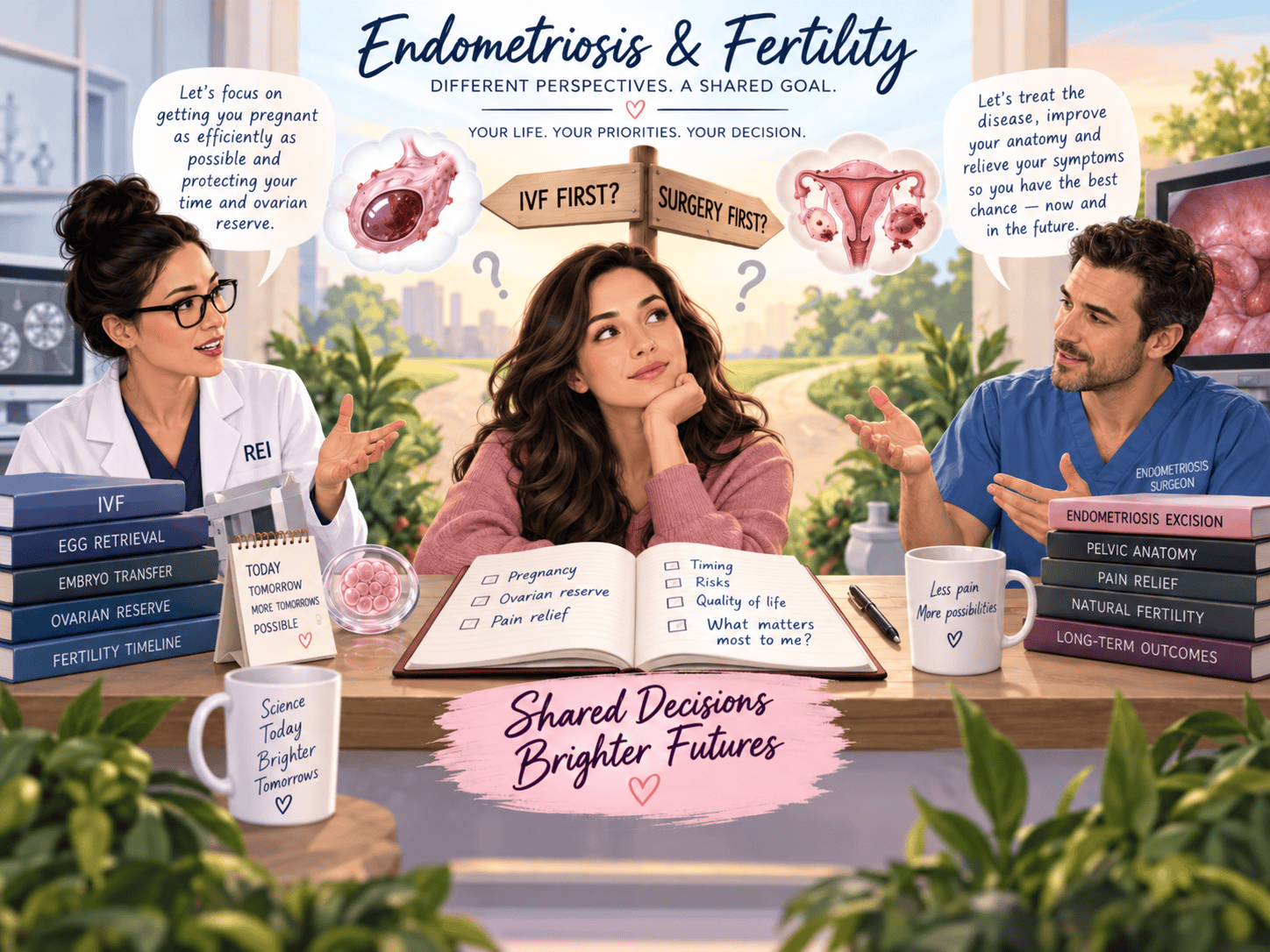
Haering or reading different advice about endometriosis and fertility is common
Why your reproductive endocrinologist and your endometriosis surgeon may give you different advice — what the research actually says — and why the best plan is the one built around you.
If you have endometriosis and you're trying to conceive, you may have already lived this scene: one specialist tells you to have surgery, another tells you to skip surgery and go straight to IVF. Both are board-certified. Both quote studies. Both sound confident. And you leave more confused than when you started.
Here's the truth nobody puts on the pamphlet: you're not getting conflicting advice because one doctor is wrong. You're getting it because medicine genuinely hasn't settled these questions — and because two specialties look at the same disease through different lenses.
A reproductive endocrinologist (REI) is trained to get you pregnant as efficiently as possible, often with assisted reproductive technology (ART) like IVF. An endometriosis excision surgeon is trained to remove disease, restore anatomy, and treat pain. Same patient, same goal — a healthy baby and a healthy you — but different toolboxes, and different worries about what could go wrong.
Let's walk through the five debates where those toolboxes clash the hardest.
Controversy #1: Do you need surgery just to diagnose endometriosis before fertility treatment?
In the REI's office, you might hear: "We don't need a laparoscopy to know what's going on. Your ultrasound and MRI, plus your symptoms, tell us enough. A diagnostic surgery just adds risk, cost, and months of delay before we start treating your infertility."
In the surgeon's office, you might hear: "Imaging is only as good as the person reading it — and standard ultrasound can completely miss superficial peritoneal disease, the most common form of endometriosis. If we never look, we may never know what's driving your infertility and pain, and 'unexplained infertility' sometimes isn't unexplained at all."
What the evidence says: This is one of the biggest recent shifts in the field. The 2022 ESHRE guideline — a full revision of the 2014 version — no longer treats laparoscopy as the diagnostic gold standard; surgery is now recommended mainly when imaging is negative or when empiric treatment has failed or isn't appropriate. In other words, the world's leading reproductive society moved toward the REI position — but with a built-in escape hatch that validates the surgeon's concern: negative imaging does not rule out endometriosis, especially superficial disease, and expert imaging (a sonographer or radiologist experienced in deep endometriosis mapping) is not equally available everywhere.
The honest bottom line: Diagnostic-only surgery is falling out of favor. But if surgery is being considered for treatment — pain, an endometrioma, suspected deep disease — diagnosis and treatment can happen in the same operation, which changes the math entirely.
Controversy #2: Surgery first or IVF first?
This is the argument — the one that plays out in tumor-board-style meetings, conference debates, and, unfortunately, in the middle of patients' care plans.
In the REI's office, you might hear: "IVF is the fastest, most predictable route to pregnancy — especially if you're over 35, your ovarian reserve is declining, or there are other fertility factors like tubal disease or a sperm issue. Surgery means recovery time, possible complications, and months lost. The eggs you have today are the youngest eggs you'll ever have."
In the surgeon's office, you might hear: "Excision restores your anatomy and may let you conceive naturally — not just once, but for every future pregnancy, without needles, stimulation cycles, or the cost of IVF. And it's the only option that also treats your pain. IVF treats a symptom of endometriosis; it doesn't treat the disease you'll still live with afterward."
What the evidence says: For minimal-to-mild (stage I–II) disease, we actually have randomized controlled trials — and they disagree with each other, which is fitting. The landmark Canadian trial (Marcoux, New England Journal of Medicine, 1997) randomized women to surgical treatment versus diagnostic laparoscopy alone and found meaningfully higher pregnancy rates after treatment; a smaller Italian trial found no benefit. Pooled together in Cochrane analyses, operative laparoscopy appears to modestly improve pregnancy rates — with a number needed to treat often quoted around 10–12, meaning roughly one extra pregnancy for every dozen surgeries. Real, but modest.
Two tools help personalize this decision rather than fight about it. First, the Endometriosis Fertility Index (EFI) — a validated score calculated during surgery that predicts your chance of natural conception afterward. ESHRE's 2022 guideline specifically added the EFI as a decision-making tool for choosing the best route to pregnancy after endometriosis surgery. A high EFI supports trying naturally; a low EFI supports moving to IVF promptly. Second, plain biology: age and ovarian reserve. The younger you are and the better your reserve, the more affordable a "surgery-then-try-naturally" window becomes. The older you are, the stronger the case for prioritizing IVF — with or without surgery.
The honest bottom line: Neither "always operate first" nor "always IVF first" survives contact with the evidence. Your age, ovarian reserve, pain level, disease stage, other fertility factors, finances, and how you feel about surgery versus IVF should each get a vote.
Controversy #3: The endometrioma dilemma — remove the "chocolate cyst" before IVF, or leave it alone?
If there's one topic guaranteed to generate a polite disagreement between an REI and a surgeon, it's the ovarian endometrioma.
In the REI's office, you might hear: "Removing that cyst can permanently damage your ovarian reserve. Studies show AMH (a key reserve marker) can drop substantially after cystectomy, because healthy ovarian tissue often comes off with the cyst wall. And the data suggest taking it out doesn't improve your IVF success anyway. Unless it's causing pain or blocking my access to your follicles, I'd rather stimulate around it."
In the surgeon's office, you might hear: "Leaving it isn't free either. Endometriomas can grow, rupture, or become infected — including rare but serious abscesses after egg retrieval needles pass near them. The cyst fluid is inflammatory, we can't biopsy what we don't remove (a small but real cancer-exclusion concern, especially with atypical features), and if it's causing pain, IVF won't fix that. In experienced hands, with reserve-sparing technique, excision can be done carefully."
What the evidence says: This is a rare controversy where the major guidelines and systematic reviews largely agree — and they lean toward restraint. The most-cited systematic review and meta-analysis (Hamdan et al., Human Reproduction Update, 2015) found that women with endometriomas undergoing IVF had similar live birth rates to women without them, and that surgery beforehand did not improve IVF outcomes. Meta-analyses of AMH levels after cystectomy (Raffi et al., 2012) documented an average post-operative drop of roughly a third — sobering, especially with bilateral cysts or repeat surgery. Accordingly, guidance reflects that for endometriomas, there's no good evidence that cystectomy before ART improves pregnancy rates, and surgery beforehand should mainly be considered to treat pain or improve access to follicles — and the ASRM committee opinion concludes that surgery does not appear to benefit asymptomatic women with an endometrioma before planned IVF/ICSI.
But — and this matters — no randomized trial has directly compared endometrioma excision to expectant management before IVF/ICSI, and the surgeon's concerns about abscess risk after retrieval, symptom relief, and ruling out rare malignancy are legitimate reasons individual patients still reasonably choose surgery.
The honest bottom line: For an asymptomatic, classic-appearing endometrioma before IVF, the evidence favors leaving it. For a painful, large, growing, suspicious, or retrieval-obstructing cyst — or for someone who also wants years of pain relief, not just a pregnancy — surgery by a high-volume endometriosis surgeon using ovary-sparing technique is a defensible, sometimes preferable path. Whatever you choose, ask how the plan protects your ovarian reserve.
Controversy #4: Deep endometriosis (bowel, bladder, nerves) — operate before trying to conceive, or go straight to IVF?
Deep infiltrating endometriosis (DIE) — nodules invading the bowel, bladder, ureters, or pelvic nerves — is where the stakes on both sides get highest.
In the REI's office, you might hear: "This is major surgery — we're talking about possible bowel resection, with real risks like leaks, fistulas, or a temporary stoma. There are no randomized trials proving it improves fertility, and IVF success rates in women with deep disease are reasonable without operating. Why accept those risks before we've even tried?"
In the surgeon's office, you might hear: "Observational studies and meta-analyses consistently show that after complete excision of deep disease, many women conceive naturally — sometimes after years of failed treatment — and some data suggest better ART outcomes too. Beyond fertility: deep disease usually hurts. Painful sex, painful bowel movements, sciatic-type nerve pain. IVF, even when it works, leaves all of that untouched."
What the evidence says: This is genuinely the least settled controversy of the five — we still lack completed randomized trials comparing excision-then-conception versus IVF-first in deep disease. Observational series and pooled analyses suggest meaningful spontaneous pregnancy rates after expert DIE excision, but observational data can't fully separate the surgery's effect from patient selection. What is well established: complication rates of bowel-involved surgery are not trivial and are strongly tied to surgical experience and multidisciplinary support, and pain and quality-of-life improvements after complete excision are substantial for most patients. Guidelines therefore decline to issue a blanket rule and push the decision toward symptoms, priorities, and expertise.
The honest bottom line: If your deep disease is quiet and your only goal right now is a baby, IVF-first is reasonable. If your deep disease is loud — pain that's stealing your life — surgery may serve both goals, but only in a high-volume center with a multidisciplinary team (colorectal, urology, and when nerves are involved, surgeons trained in neuropelveology). Volume and team structure are not luxuries here; they are the safety data.
Controversy #5: Should you "suppress" endometriosis with hormones before IVF?
In the (traditional) REI's office, you might have heard: "Let's quiet the disease down first — a few months of GnRH agonist (medications like Lupron) before your IVF cycle to reduce inflammation and improve implantation. Older studies showed dramatically better pregnancy rates with this 'ultralong protocol.'"
In the surgeon's office (and, increasingly, in evidence-updated REI offices), you might hear: "Suppression doesn't remove disease — lesions and fibrosis are still there when the medication wears off. Meanwhile you've spent months in a menopause-like state, with hot flashes and bone-density concerns, delaying treatment. And the modern evidence for a fertility benefit has largely evaporated."
What the evidence says: This one is a fascinating case study in how medicine corrects itself. A 2006 Cochrane review suggested a large benefit from months of GnRH agonist before IVF, and the ultralong protocol became widespread. The 2019 Cochrane update, applying stricter methods to the accumulated trials, concluded the evidence was too weak and uncertain to support it. The guideline followed: ESHRE's 2022 revision no longer recommends the ultralong GnRH-agonist protocol before ART, citing unclear benefit on live birth rates — and it also strongly recommends against post-surgery hormonal suppression when it's given solely to enhance future pregnancy rates.
One important nuance so nothing gets confused: hormonal suppression remains a cornerstone of pain management and of preventing recurrence when you're not actively trying to conceive. The controversy is specifically about using it as a fertility-boosting step — and there, the evidence has moved on.
The honest bottom line: If someone proposes months of suppression purely to improve your IVF odds, it's fair to ask which evidence they're relying on — and whether that time is better spent on treatment itself.
So who's right? (Spoiler: the version of the plan that fits you.)
Notice the pattern across all five controversies. The REI's instincts protect your time and your eggs. The surgeon's instincts protect your anatomy, your pain-free years, and your whole-person health. Both instincts are correct. The mistake is letting either one operate alone.
That's why the strongest recommendation in this entire article isn't about surgery or IVF at all — it's about process:
1. Insist on individualization. Your age, AMH and antral follicle count, disease location and stage, pain burden, prior surgeries, partner factors, finances, and personal values are the actual inputs. Any advice given before those are known is a template, not a plan.
2. Ask for the tools that personalize. If surgery happens, ask whether your EFI score will be calculated. If IVF is proposed, ask how your endometriosis specifically was factored into the protocol.
3. Seek teams, not tiebreakers. The best endometriosis centers put the REI and the surgeon in the same room — a multidisciplinary team reviewing your case together — so you receive one integrated plan instead of two competing sales pitches.
4. Claim your seat at the table. Every major guideline now frames these decisions as shared decision-making for a reason: when the evidence is genuinely uncertain, your priorities — fastest pregnancy? pain relief? avoiding surgery? avoiding IVF? preserving fertility for later? — are not a footnote. They're the deciding vote.
You are not being difficult when you ask a second specialist's opinion. You are doing exactly what the evidence, honestly read, tells all of us to do: hold both perspectives at once, and build the plan around the only expert on your goals — you.
This article is for education and isn't a substitute for individualized medical advice. Bring these questions to your own care team.