
Lost in Classification: Finding Meaning Beyond the rASRM Score
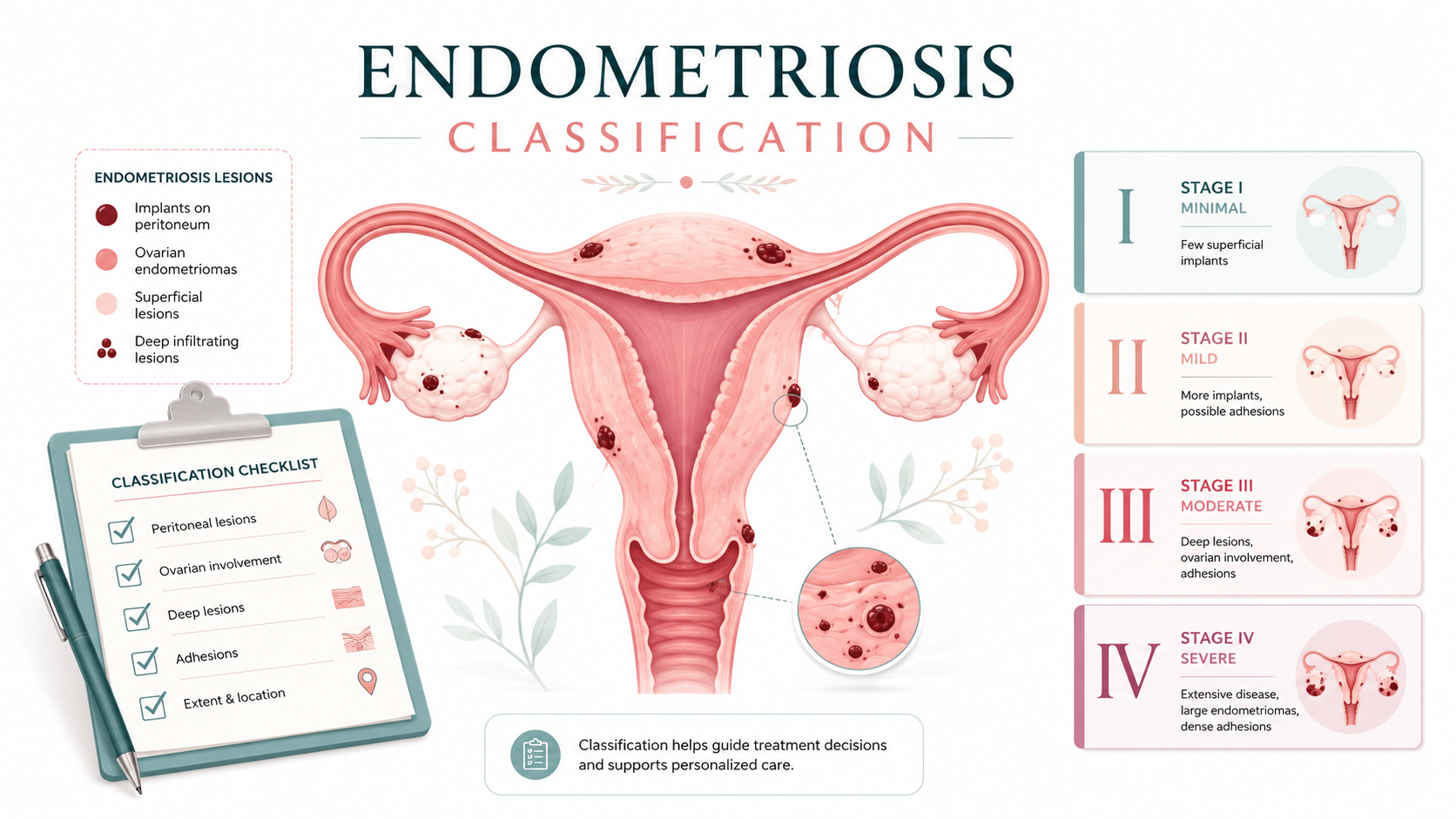
more than 30 Classifications exist ,but rASRM is the most commonly used despite its limitations.
The rASRM Classification of Endometriosis: What the Stages Do—and Do Not—Tell Us
Being told that you have “Stage 1” or “Stage 4” endometriosis can sound frightening. Many patients naturally assume that a higher stage means more pain, a lower chance of pregnancy, or a more difficult operation.
That is not necessarily true.
The revised American Society for Reproductive Medicine classification, commonly called the rASRM classification, is primarily a scoring system for describing certain anatomical findings seen during surgery. It provides a useful shared language, but it does not fully describe how endometriosis affects an individual patient.
A helpful way to remember this is:
The rASRM stage describes selected surgical findings. It does not measure how much a patient is suffering.
What Should an Ideal Endometriosis Classification Accomplish?
Before judging the rASRM system, we should first ask what an endometriosis classification is supposed to do.
An ideal classification would help answer several different questions:
Clinical questionWhat an ideal classification should tell usWhere is the disease?The location, size and depth of each lesionHow severe are the symptoms?The likely effect on pain and quality of lifeWhat is the fertility outlook?The likelihood of natural conception or the need for fertility treatmentHow difficult will surgery be?The expected operating time, surgical expertise and multidisciplinary support requiredWhat is the prognosis?The risk of persistent symptoms, recurrence or organ dysfunctionWill treatment work?The likely response to medication, surgery or fertility treatmentCan researchers compare patients?A standardized description that allows meaningful comparison between studiesCan the disease be classified before surgery?A reliable map based on examination, ultrasound or MRI
The World Endometriosis Society has emphasized that an ideal system should be standardized, practical, user-friendly and useful for outcomes that matter to patients. These include pain, fertility, quality of life, prognosis, treatment response and recurrence—not simply the appearance of disease during surgery.
No currently available classification accomplishes all these goals.This is why endometriosis is increasingly described using a toolbox of complementary systems, rather than relying on one stage alone.
What Is the rASRM Classification of Endometriosis?
The rASRM classification is the 1996 revision of a system originally developed by the American Fertility Society. It remains one of the best-known methods of surgically staging endometriosis.
During laparoscopy, the surgeon assigns points according to selected findings, including:
Superficial and deep lesions on the pelvic peritoneum
Superficial and deep ovarian lesions
The size of the lesions
Filmy or dense adhesions involving the ovaries
Filmy or dense adhesions involving the fallopian tubes
The proportion of an ovary or tube enclosed by adhesions
Partial or complete obliteration of the posterior cul-de-sac, also called the pouch of Douglas
The points are added together to produce one of four stages.
rASRM stageScoreTraditional descriptionStage I1–5 pointsMinimalStage II6–15 pointsMildStage III16–40 pointsModerateStage IVMore than 40 pointsSevere
These labels can be misleading. “Minimal” disease does not necessarily mean minimal pain, while “severe” disease does not mean that every pelvic organ is affected.
The final score is strongly influenced by ovarian endometriomas, adhesions and obliteration of the posterior cul-de-sac. Complete cul-de-sac obliteration alone receives 40 points, illustrating how one finding can substantially influence the final stage.
Strengths of the rASRM Classification
1. It Provides a Common Clinical Language
The greatest strength of the rASRM classification is familiarity. Surgeons, fertility specialists and researchers around the world understand what is meant by Stage I, II, III or IV endometriosis.
This makes it easier to summarize operative findings, communicate between healthcare professionals and organize broad groups of patients in research.
2. It Encourages Systematic Surgical Assessment
Completing an rASRM score encourages the surgeon to inspect and document the ovaries, fallopian tubes, pelvic peritoneum, adhesions and posterior cul-de-sac.
A structured score is generally more useful than an operative note that simply says “mild” or “severe endometriosis” without explaining what was found.
3. It Is Relatively Simple
Although the detailed scoring sheet takes some practice, the final four-stage result is easy to communicate.
Patients can remember a stage more easily than a long list of anatomical findings. The stage can therefore act as a convenient summary—provided that it is not mistaken for a complete description of the disease.
4. It Has Historical Value in Research
Because the rASRM classification has been used for decades, it allows some comparison with older studies and clinical databases.
This is particularly valuable when reviewing long-term trends. However, this strength also creates pressure to continue using the system even when a different classification might better answer a specific clinical question.
Weaknesses of the rASRM Classification
1. The Stage Correlates Poorly With Pain
One of the most important limitations is that the rASRM stage does not reliably predict pain severity.
A patient with Stage I disease may experience disabling menstrual pain, painful intercourse, bowel symptoms or daily pelvic pain. Another patient with Stage IV disease may have relatively little pain and may only discover the condition during an infertility evaluation or unrelated operation.
Reviews of endometriosis classification systems have found little reliable correlation between rASRM stage and pain or quality of life.
This happens because pain is more complex than the visible amount of disease. It may be influenced by:
The precise location of a lesion
Irritation or involvement of pelvic nerves
Deep disease in the uterosacral ligaments, vagina, bowel or bladder
Pelvic-floor muscle dysfunction
Inflammation
Central sensitization of the nervous system
Adenomyosis
Other overlapping pain conditions
The rASRM score does not adequately measure most of these factors.
Therefore, the stage should never be used to dismiss a patient’s symptoms. Low-stage disease can still cause severe, life-altering pain.
2. It Is a Weak Predictor of Fertility
The earlier American Fertility Society system was developed partly in an effort to connect surgical findings with fertility. However, the rASRM stage alone does not predict an individual patient’s likelihood of pregnancy particularly well.
ASRM has acknowledged that traditional endometriosis staging systems correlate poorly with the chance of conception following treatment.
Fertility depends on much more than the visible amount of endometriosis. Important factors include:
Age
Ovarian reserve
Duration of infertility
Previous pregnancies
Fallopian-tube function
Ovarian and tubal anatomy after surgery
Sperm quality
Other reproductive conditions
For patients attempting pregnancy after endometriosis surgery, the Endometriosis Fertility Index, or EFI, is more useful than the rASRM stage alone. The EFI combines historical factors with an assessment of ovarian, tubal and fimbrial function after surgery. It was specifically developed and validated to estimate the probability of non-IVF pregnancy following surgical treatment.
Even the EFI should be interpreted as part of a complete fertility evaluation rather than as a guarantee of pregnancy.
3. It Does Not Describe Deep Endometriosis Well
The rASRM system places considerable emphasis on superficial lesions, ovarian disease and adhesions. It does not adequately map many retroperitoneal and deep locations, including disease affecting the:
Ureters
Bladder muscle
Rectum or sigmoid colon
Rectovaginal septum
Vagina
Pelvic sidewall
Parametrium
Pelvic nerves
Diaphragm or other extrapelvic sites
This can create clinically important mismatches.
For example, a relatively small deep lesion involving the ureter or bowel may receive limited rASRM recognition but require advanced dissection, colorectal support or urological involvement. Conversely, extensive ovarian adhesions can generate a high rASRM score without requiring the same type of multidisciplinary operation.
Studies comparing rASRM with the #Enzian system have demonstrated that clinically important deep disease may occur across all rASRM stages, including patients classified as Stage I.
4. The Stage Does Not Reliably Predict Surgical Complexity
The rASRM stage is sometimes used as shorthand for how difficult an operation will be, but it was not designed as a surgical-complexity score.
Surgical difficulty may depend on:
Bowel, bladder or ureteric involvement
Retroperitoneal fibrosis
Pelvic sidewall disease
Distortion of normal anatomy
Previous operations
Dense adhesions
Large endometriomas
The need for organ resection or reconstruction
The surgeon’s experience and available multidisciplinary team
The AAGL 2021 Endometriosis Classification was specifically designed to improve the assessment of operative complexity. Its original validation found that it discriminated levels of surgical complexity better than the rASRM system.
However, newer classifications are not perfect either. Research has identified concerns about observer agreement with the AAGL system, showing that further simplification, training and validation may still be required.
5. Different Surgeons May Produce Different Scores
rASRM scoring depends on visual estimates of lesion size, depth, adhesion density and the percentage of an organ enclosed by adhesions.
These judgments can vary between surgeons. The view may also be affected by bleeding, fibrosis, previous surgery, incomplete pelvic inspection or the inability to safely separate organs before scoring.
Reproducibility is particularly limited when ovarian adhesions and posterior cul-de-sac disease are involved.
Photographs, video recording, standardized training and detailed operative diagrams can improve documentation, but they do not completely eliminate subjectivity.
6. Patients With the Same Stage May Have Very Different Disease
A stage is the result of a total number of points. Different combinations of findings can produce the same total.
Two patients with Stage IV disease might therefore have very different conditions:
One may have bilateral endometriomas and extensive ovarian adhesions.
Another may have complete cul-de-sac obliteration.
Another may have tubal adhesions with comparatively limited visible lesions.
A patient with complex bowel or ureteric disease may still not be adequately described by the final rASRM number.
For clinical decision-making, the anatomical details are often more important than the stage itself.
7. It Does Not Include the Patient’s Symptoms or Priorities
The rASRM score does not include pain, bowel or urinary symptoms, sexual function, fatigue, quality of life, desire for pregnancy, ovarian reserve or response to previous treatment.
It classifies selected lesions—not the whole patient.
This is why treatment should never be determined by stage alone. A patient with Stage I disease and disabling pain may require more support than an asymptomatic patient with Stage IV disease. The correct plan depends on symptoms, fertility priorities, examination, imaging, previous treatment and personal preferences.
Preoperative Versus Intraoperative Classification
One of the most important developments in modern endometriosis care is the distinction between preoperative mapping and intraoperative classification.
What Is a Preoperative Classification?
A preoperative classification describes the suspected disease before an operation. It may be based on:
Clinical history
Pelvic examination
Specialist transvaginal ultrasound
MRI
Assessment of organ mobility and the pelvic “sliding sign”
Identification of endometriomas
Mapping of deep bowel, bladder, vaginal or ureteric disease
Signs of adhesions or cul-de-sac obliteration
The purpose is not simply to decide whether endometriosis is present. Preoperative mapping should help determine:
Whether surgery is appropriate
The experience required from the surgeon
Whether colorectal or urological support may be needed
The likely operating time
The risk of organ injury or resection
What should be discussed during informed consent
The 2022 ESHRE guideline marked an important shift away from treating laparoscopy as the automatic diagnostic gold standard. Endometriosis can now be diagnosed clinically or through imaging in appropriate patients, while laparoscopy is generally considered when imaging is negative and empirical treatment is unsuccessful, unsuitable or not desired.
A normal ultrasound or MRI does not completely exclude endometriosis, particularly superficial peritoneal disease. Nevertheless, high-quality imaging can provide essential information about ovarian and deep endometriosis before surgery.
What Is an Intraoperative Classification?
An intraoperative classification is completed during surgery, when the surgeon can directly inspect the pelvis.
The rASRM system is fundamentally an intraoperative classification. A formal rASRM score cannot usually be assigned with confidence from symptoms or routine imaging because it requires detailed assessment of superficial lesions and adhesions.
Intraoperative assessment can:
Confirm or revise the preoperative map
Identify superficial disease that was not visible on imaging
Assess adhesions directly
Document unexpected disease
Record the anatomy before and after treatment
Provide information for postoperative fertility tools such as the EFI
However, surgery also has limitations. The findings depend on how thoroughly the pelvis is inspected, the surgeon’s expertise and whether anatomical spaces are opened safely enough to identify deep disease.
Why Preoperative and Intraoperative Systems Should Work Together
Preoperative and intraoperative classifications should not compete with one another. They answer different questions.
A modern approach can be summarized as:
Map before surgery, confirm during surgery, and measure outcomes after surgery.
The #Enzian classification is particularly valuable because it was designed to describe superficial, ovarian and deep endometriosis by anatomical location and lesion size, and it can be applied to both imaging and surgical findings. This allows radiologists, sonographers and surgeons to communicate using a more consistent anatomical language.
Which Classification Should Be Used?
There is no single best classification for every purpose.
PurposeMost relevant approachBroad traditional surgical stagerASRMDetailed mapping of deep disease#EnzianPreoperative anatomical planningSpecialist ultrasound or MRI, often reported with #Enzian terminologyIntraoperative surgical complexityAAGL 2021 classification, operative details and procedure performedNatural pregnancy prognosis after surgeryEndometriosis Fertility IndexPain and quality of lifeValidated patient-reported symptom and quality-of-life questionnairesResearch standardizationA combination of anatomical classification, symptom data, imaging, surgical findings and standardized outcome reporting
The World Endometriosis Society has therefore recommended a classification “toolbox” that may include rASRM, Enzian and the EFI, depending on the clinical situation.
What Would a Better Endometriosis Classification Look Like?
Rather than forcing every aspect of endometriosis into one number, the ideal future system may resemble a multidimensional dashboard.
It would include at least five connected components.
1. A Patient-Centered Symptom Profile
This should document menstrual pain, non-menstrual pelvic pain, painful intercourse, bowel symptoms, urinary symptoms, fatigue, sexual function and quality of life.
2. A Preoperative Anatomical Map
Specialist ultrasound or MRI should describe the location and size of endometriomas and deep lesions, organ involvement, adhesions and distortion of pelvic anatomy.
3. An Intraoperative Disease Map
Surgery should confirm superficial, ovarian and deep disease using standardized terminology, photographs or video and clear documentation of what was treated.
4. Outcome-Specific Prognostic Tools
Different tools should be used for different outcomes:
Fertility prognosis
Surgical complexity
Pain response
Recurrence
Organ function
Quality of life
A single anatomical stage is unlikely to predict all of them accurately.
5. Standardized Research Data
Researchers need consistent definitions of symptoms, disease phenotypes, imaging findings, surgical techniques, completeness of treatment and patient-reported outcomes.
Reviews of existing systems have found that most classifications have limited validation against the outcomes patients care about most. Better standardization would make studies easier to compare and help identify which treatments work best for particular disease phenotypes.
The Bottom Line
The rASRM classification remains a useful and recognizable way to summarize selected findings seen during endometriosis surgery.
Its strengths are simplicity, familiarity and historical research value. Its main weakness is that it is often asked to answer questions it was never designed to answer.
The rASRM stage alone does not reliably tell us:
How much pain a patient experiences
How much endometriosis affects quality of life
Whether natural pregnancy will occur
How difficult surgery will be
Whether bowel, bladder, ureteric or nerve disease is present
Which treatment is best
Whether symptoms will return
The most useful endometriosis assessment combines the patient’s symptoms and priorities with specialist imaging, detailed anatomical mapping, appropriate surgical documentation and outcome-specific tools such as the EFI.
Endometriosis care should therefore be guided by the whole clinical picture—not by a Roman numeral alone.
Frequently Asked Questions
Does Stage IV endometriosis always cause the worst pain?
No. rASRM stage and pain severity correlate poorly. A patient with Stage I disease may have severe pain, while someone with Stage IV disease may have mild symptoms.
Does Stage I endometriosis mean the disease is insignificant?
No. “Minimal” describes the rASRM surgical score, not the effect of the disease on the patient. Low-stage disease may still cause disabling pain or infertility.
Can an ultrasound or MRI determine the rASRM stage?
Not reliably. The rASRM score depends on detailed surgical assessment of superficial lesions and adhesions. Imaging is better used to create a preoperative anatomical map, particularly for endometriomas and deep endometriosis.
Does the rASRM stage predict pregnancy?
Not accurately enough to guide decisions by itself. Age, ovarian reserve, sperm factors, tubal function and other variables are also important. After surgery, the Endometriosis Fertility Index provides more useful information about the likelihood of non-IVF pregnancy.
Which system is best for deep endometriosis?
The #Enzian classification provides a more detailed description of deep disease by location and lesion size and can be used with specialist imaging as well as surgical findings.
Should the rASRM classification be abandoned?
Not necessarily. It remains useful as part of a broader classification toolbox. The problem arises when the stage is treated as a complete measure of pain, fertility, prognosis or surgical difficulty.
Medical disclaimer: This article provides general educational information and is not a substitute for individualized medical advice, diagnosis or treatment.