
You’ve been experiencing excruciating pain with bowel movements. You’re dealing with severe bloating, constipation, or diarrhea that mysteriously flares up during your period. You finally get a referral to a gastroenterologist, go through the dreaded prep, and have a colonoscopy.
When you wake up, the doctor delivers the news: "Everything looks perfectly normal."
For a moment, you might feel relief. But then reality sets in. If everything is normal, why are you in so much pain? Are these symptoms all in your head?
If you suspect you have bowel endometriosis, they absolutely are not in your head. A "clear" colonoscopy is incredibly common in patients with bowel endometriosis. Here is why this happens, and why you shouldn't rule out the disease just because you aren't seeing blood.
The "Outside-In" Problem
To understand why a colonoscopy misses endometriosis, we have to look at how your bowel is built and how endometriosis grows.
Think of your intestines like a multi-layered garden hose.
As you can see in the diagram, your bowel has distinct layers:
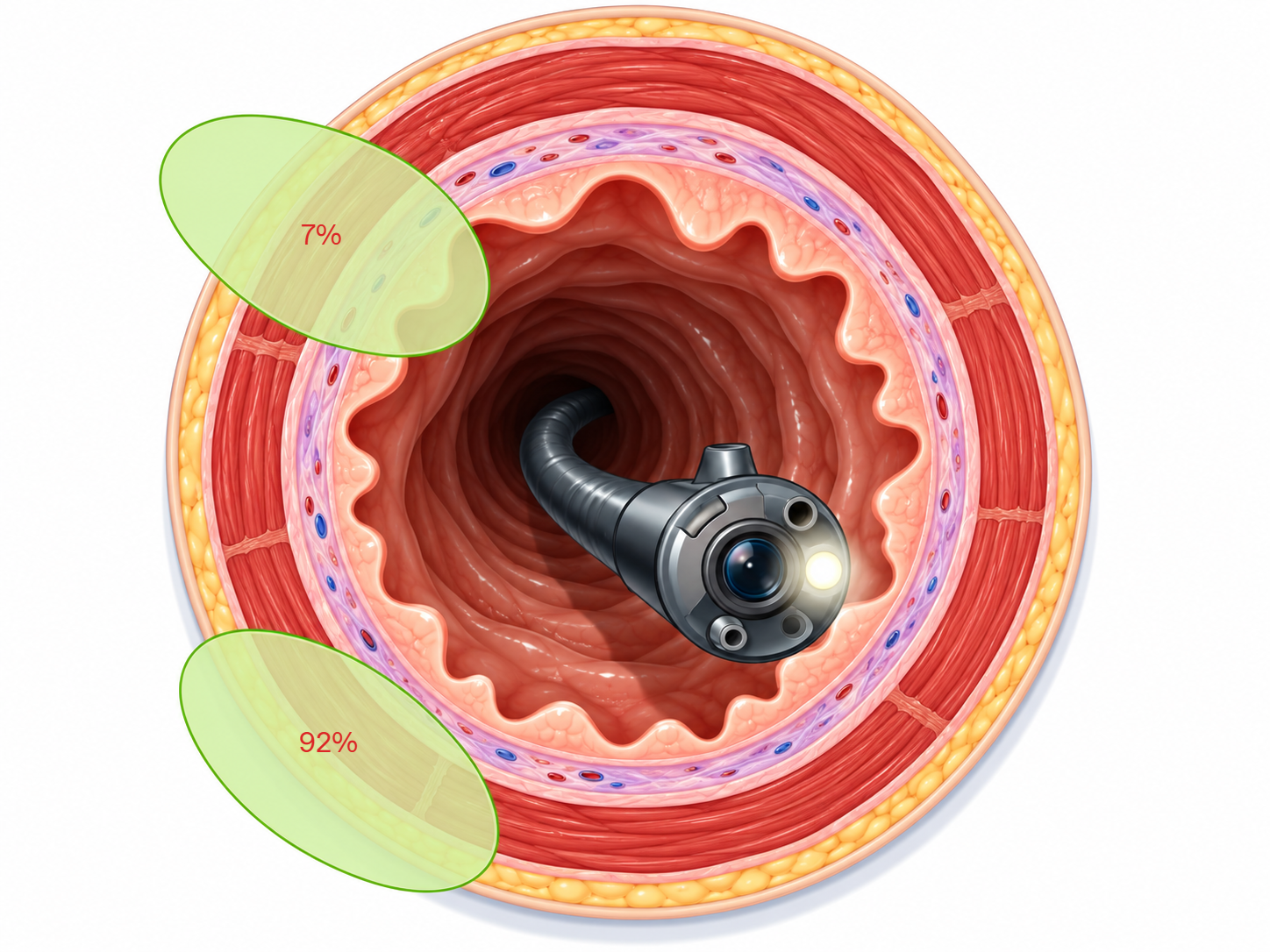
Less than 7% of bowel endometriosis nodule invade the innermost layer .
1. The Mucosa: The innermost lining (the inside of the hose where the food/waste passes)
2.The Submucosa & Muscularis: The thick, middle muscle layers that contract to move waste along.
3. The Serosa: The smooth, outermost covering of the bowel (the outside of the hose).
A colonoscopy is a camera that travels inside the hose. It only looks at the innermost lining (the mucosa). It is a fantastic tool for finding polyps, Crohn's disease, or colon cancer—conditions that start on the inside of the bowel.
Endometriosis, however, starts on the outside.
Endometriosis is a disease where tissue similar to the lining of the uterus grows outside the uterus. When it attacks the bowel, it lands on the outer layer (the serosa). Over time, the lesions can burrow deeper into the thick muscle wall (the muscularis). But it is actually very rare for endometriosis to break all the way through to the innermost lining.
Because the lesions are trapped in the outer and middle layers, a camera gliding through the inside of the bowel will just see a perfectly smooth, healthy pink wall. The doctor cannot see the disease, the scar tissue, or the way your bowel might be glued to your uterus on the other side of that wall.
Why Rectal Bleeding is Uncommon
One of the biggest misconceptions—even among some doctors—is that if you have bowel endometriosis, you will have rectal bleeding during your period.
Because the endometriosis rarely penetrates that final inner layer (the mucosa), it doesn't create open wounds or shedding on the inside of your colon. Without a breach of the inner lining, blood cannot enter your stool.
While a small percentage of patients do experience cyclical rectal bleeding (if the lesion is exceptionally deep), the vast majority do not. The absence of blood does not mean an absence of disease.
So, What Are the Real Symptoms?
If it's not bleeding, what does bowel endometriosis actually feel like? Because the disease infiltrates the muscle wall and creates sticky scar tissue (adhesions) on the outside of the bowel, the symptoms are primarily structural and inflammatory:
Dyschezia: Deep, sharp, or shooting pain during bowel movements, especially during your period.
"Endo Belly": Severe, painful bloating caused by inflammation.
Digestive extremes: Alternating diarrhea and constipation, often misdiagnosed as Irritable Bowel Syndrome (IBS).
Pelvic pulling: A sensation of pulling or dragging in your pelvis, often because scar tissue has physically fused your bowel to your vaginal wall, ovaries, or uterus.
Your Next Steps for Answers
If you have a clear colonoscopy but still suspect bowel endometriosis, do not give up. You need a medical team that understands how to look for the disease properly.
Seek an Excision Specialist: Look for a gynecologic surgeon who specializes in the advanced excision of endometriosis, not just a general OB-GYN or a standard GI doctor.
Ask for Specialized Imaging: Standard ultrasounds often miss it, but an expert can perform an advanced transvaginal ultrasound with bowel preparation, or order a pelvic MRI with contrast specifically protocolled to look for deep infiltrating endometriosis (DIE).
Trust Your Body: You live in your body every single day. If your symptoms are interfering with your quality of life, keep advocating for yourself until you find a doctor who listens.
A clear colonoscopy just means the inside of the pipe is clean. It says absolutely nothing about the storm happening on the outside.