
“Stuck on High Alert: The Central sensitization syndrome’s Role in Endometriosis Pain
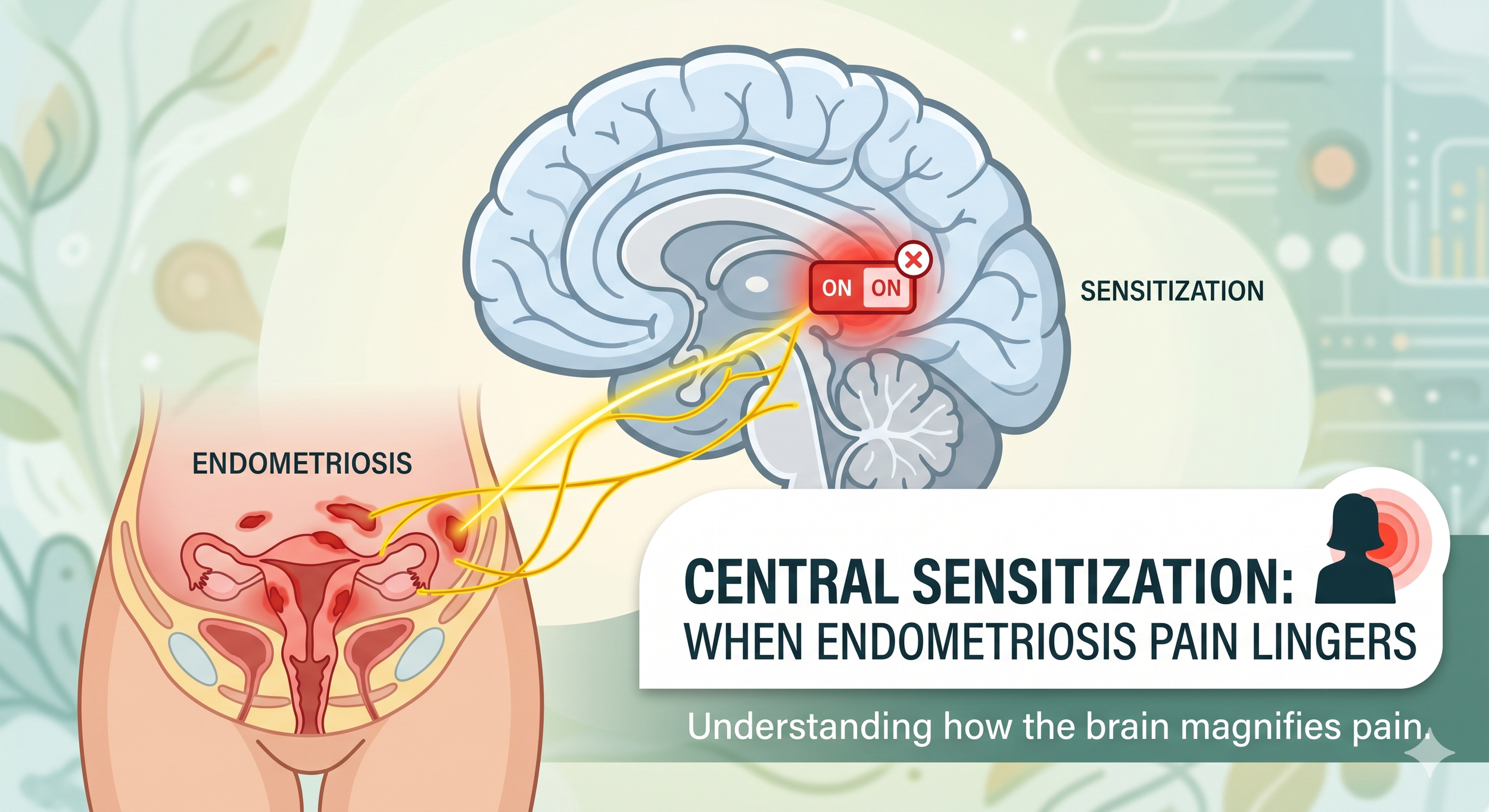
Why does your nervous system keep sending the alarm long after the fire is out? A deep dive into one of endometriosis's most underrecognized — and surgically relevant — complications.
“When the Volume Knob Gets Stuck: Chronic Sensitization Syndrome in Endometriosis”
Endometriosis is often described as a disease of misplaced tissue—but for many patients, the story does not end with lesions alone. A growing body of evidence highlights a more complex layer: the nervous system itself can become persistently amplified. This phenomenon, broadly referred to as central sensitization syndrome, plays a critical role in pain perception, treatment response, and surgical outcomes.
What Is Central Sensitization Syndrome?
Central sensitization syndrome (CSS) refers to a state in which the nervous system becomes hyper-responsive to stimuli, leading to exaggerated and persistent pain. It encompasses both:
Peripheral sensitization: Increased sensitivity of nerve endings at sites of tissue injury or inflammation (such as endometriotic lesions).
Central sensitization: Amplification of pain signals within the spinal cord and brain, resulting in pain that is disproportionate to—or independent of—ongoing tissue damage.
In endometriosis, repeated inflammatory signaling, cyclic bleeding, and nerve infiltration can “train” the nervous system to remain in a heightened state of alert, even after lesions are treated.
How Is It Diagnosed?
There is no single definitive test for CSS. Diagnosis is clinical and multidimensional, relying on a combination of patient history, symptom patterns, and validated tools.
Key Clinical Clues
Pain that persists despite adequate surgical or hormonal treatment
Pain extending beyond typical pelvic boundaries (e.g., back, legs, bladder, bowel)
Associated conditions such as fibromyalgia, irritable bowel syndrome, or migraines
Heightened sensitivity to touch, pressure, or non-painful stimuli (allodynia)
Assessment Tools
Several instruments can help quantify central sensitization:
Central Sensitization Inventory (CSI) – widely used screening questionnaire
Quantitative Sensory Testing (QST) – evaluates pain thresholds and responses
Pain mapping and detailed symptom diaries
Importantly, CSS should not be interpreted as “psychological pain”—it reflects real neurobiological changes in pain processing.
Prevalence in Endometriosis Patients
Central sensitization is remarkably common among patients with endometriosis, particularly those with longstanding or severe disease.
Studies estimate that 40–70% of patients with chronic pelvic pain (including endometriosis) demonstrate features of central sensitization.
Higher prevalence is seen in:
Patients with delayed diagnosis
Those with multiple prior surgeries
Individuals with overlapping chronic pain syndromes
This helps explain why some patients continue to experience debilitating pain even when imaging or surgical findings appear minimal.
Why It Matters: Predicting Surgical Outcomes
One of the most clinically important aspects of CSS is its predictive value for postoperative outcomes.
Patients with High Sensitization Tend to Have:
Less pain improvement after surgery
Higher risk of persistent or recurrent pain
Greater likelihood of needing multidisciplinary pain management
Why Surgery Alone May Fall Short
Surgery targets structural disease—removing lesions, adhesions, or endometriomas. However, in sensitized patients, the pain generator has partially shifted to the nervous system itself. Removing lesions does not “reset” the amplified neural pathways.
Clinical Implication
Preoperative identification of CSS can:
Help set realistic expectations
Guide patient selection for surgery
Encourage early integration of adjunct therapies such as:
Neuromodulators (e.g., SNRIs, gabapentinoids)
Pelvic floor physical therapy
Cognitive behavioral therapy
Pain neuroscience education
A Shift in Perspective
Central sensitization challenges the traditional lesion-focused model of endometriosis. It urges clinicians and patients alike to adopt a biopsychosocial approach, recognizing that pain is not solely a reflection of visible disease.
For some patients, the goal is not simply removing endometriosis—but retraining the nervous system.
Takeaway
Chronic sensitization syndrome is a key driver of pain in endometriosis, affecting a significant portion of patients and strongly influencing outcomes after surgery. Recognizing its presence allows for more personalized care, better counseling, and ultimately, more meaningful improvement in quality of life.
In endometriosis, sometimes the problem isn’t just the lesions—it’s that the body has learned to turn the volume all the way up and forgotten how to turn it down.